TalentJam securely exposes skills matrices, gap analyses, and role profiles as machine-readable, agent-consumable outputs. The workforce intelligence layer that AI-native HR workflows, hiring agents, and workforce planning systems depend on.
Agents are already browsing the web, doing research, and managing enterprise workflows. Every major software category needs to be rebuilt for agents as first-class citizens, and workforce intelligence is no exception.


TalentJam exposes workforce intelligence through three agent-accessible interfaces, each designed for a different integration context.
Documented endpoints for the core intelligence objects. Any HTTP-capable agent or orchestration system can consume TalentJam's workforce intelligence.
The TalentJam MCP server lists available resources and exposes tools that authorised MCP-enabled agents can discover and use programmatically, without a human in the loop.
Evaluation agents doing vendor research can query TalentJam's public capability endpoints without authentication — enabling inclusion in agentic vendor shortlists.
Being callable is not enough. TalentJam is structured to be discoverable — in web search, MCP registries, and agent evaluation flows.
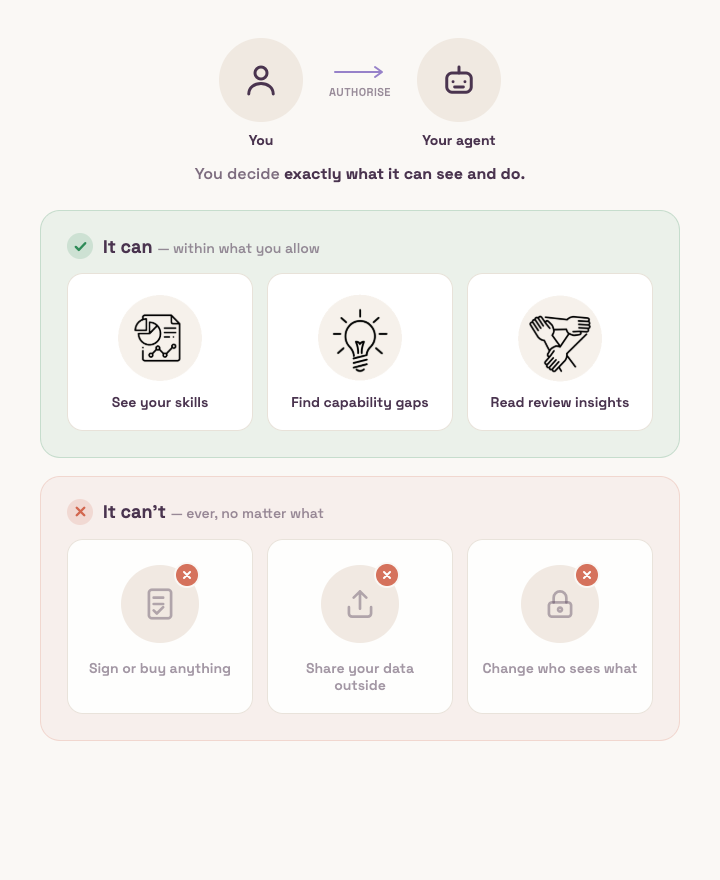
llms.txt at the site root — the emerging standard for telling AI crawlers what to do with a site. Authoritative capability description, module list, API endpoints, and fit criteria.schema.org/SoftwareApplication and schema.org/Service markup so evaluation agents can extract structured capability information without scraping.An agent should only access workforce intelligence that its human principal has authorised. This is a design principle in TalentJam's API, not a retrofit.
Talk to us about your agent integration requirements — whether you're building a hiring agent, a workforce planning system, or an AI-native HR platform that needs skills intelligence.