Services

The Operational Maturity Game (OMG)

A facilitated card game that lifts a team's maturity on a topic. The cards anchor the conversation and take the personal edge off it: people talk about the cards, not about each other.

The service

Building capability, together

A good session is one after which the team makes decisions and works more effectively. A great session is one they enjoy and want to repeat. OMG provides that: your team works through a situation (an actual or hypothetical one) in six stages on an A3 canvas (or online) with a facilitator and a deck of cards, which are carefully designed to encourage a conversation rather than supply the answers.

TalentJam or a delivery partner facilitates. The facilitator keeps time, asks questions, and does not judge, score or supply answers. A standard session runs 60 to 75 minutes with four to eight players; any manager in the room is a player like anyone else.
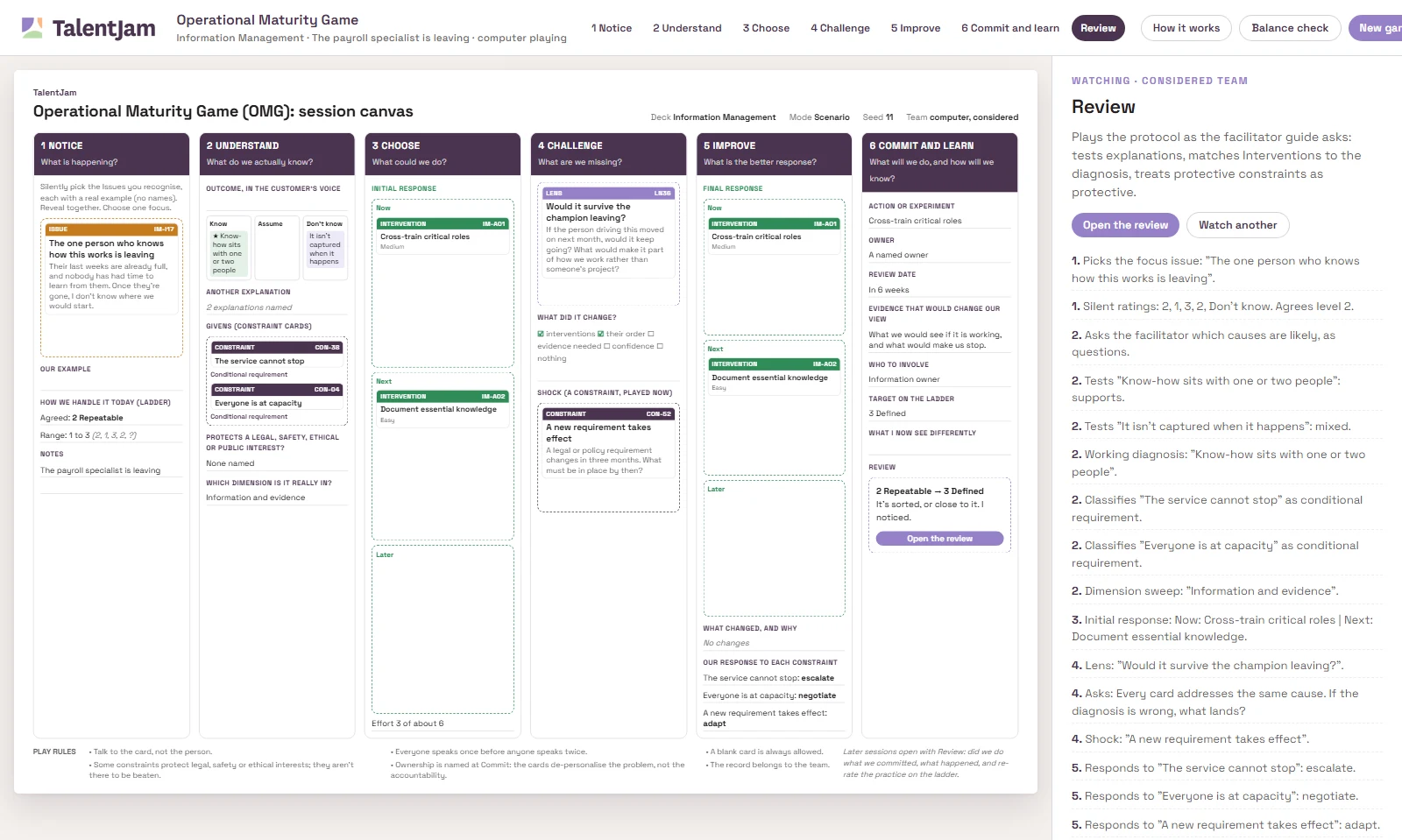
The Operational Maturity Game on screen: the A3 session canvas with its six stage columns filled in for the Information Management scenario 'The payroll specialist is leaving', from the focus Issue and the ladder rating through the Givens, the initial and final responses, the Lens and the Shock, to the commitment and its review
The A3 session canvas on screen, after a session on the Information Management deck. Illustrative example, ABC Demo Organisation.
How a session runs

Six stages, one canvas

The first three stages resist jumping to a solution. The stages are an order of work, not a script: a Lens that breaks the diagnosis sends the team back to Understand.

1 NoticeWhat is happening? Each person silently picks the Issue cards they recognise, with a real example (and ideally no names). The team chooses one or two to focus on and rates how it handles them today.
2 UnderstandWhat do we know? The causes(s) of those issues, stated in the customer's voice; what we know, assume, and don't know; and possible other explanations. Explore known constraints and what kind each is.
3 ChooseWhat could we do? An initial response of a few Interventions, placed Now, Next or Later, matched to the cause(s) the team identified.
4 ChallengeWhat are we missing? Lenses test the responses and the team says what it changed. Then revisit constraints to identify any Shocks: “We realise that it is also true that…”.
5 ImproveWhat is the better response? Revisait the responses, in light of the challenge discussion, with a reason for every change, and a deliberate response to each constraint: comply, adapt, negotiate, defer, escalate, stop, or something else.
6 Commit and learnWhat will we do, and how will we know? Record any actions, each with a named owner, review date, and the evidence that would satisfy the team, who to involve, and a maturity target on the ladder.
Every session after a team's first opens with a Review: did we do what we committed to, what happened, and how do we rate the practice now? That re-rating, session on session, is the concrete opportunity for (and evidence of) maturity uplift.
The cards

The cards prompt discussion; the value is in the conversation

Whatever the team should decide (the causes, whether the limits are real, what a choice costs) may be prompted by the cards, but working it out is the desired lift in maturity being practised.

ISSUE
What someone is experiencing, in the voice of the person who feels it. It names no cause: diagnosing it is the team's work.
INTERVENTION
A response, the cause it can address, how hard it typically is, and whether it is a stopgap or a tempting reflex.
CONSTRAINT
Environmental conditions or an event that negatively impacts the situation. Some, the team can route around, some not.
ENABLER
Something that positively impacts the situation: a sponsor, a planned change, a tool already owned. Mature teams build on what works.
LENS
Challenge questions, presented as lenses: ways of looking at the situation to understand it from different perspectives.
DIMENSION
Where an issue sits (is it a people issue, governance, process, technology, etc) and which decks cover it, shifting between the silos OMG exists to break.
WHO CAN HELP
The roles the team can turn to, and how they can contribute to the situation.
The decks

Seven domains, one shared foundation and process

Each domain deck carries its own Issues, Interventions and who-can-help cards, in the voice of the people who experience its issues. The shared deck of Constraints, Events, Enablers, Lenses and Dimensions works with every domain.

Information ManagementThe person who uses the information: finding it, trusting it, sharing it, letting it go.
CapabilityStaff, people leaders, workforce planners and executives: what the organisation can do, and who can do it.
Strategy to ExecutionDelivery staff, managers and executives: priorities, commitments, governance of delivery, benefits.
GovernanceManagers waiting on decisions, board and committee members, auditors: authority, assurance and accountability.
Operating Model and Service DeliveryThe customer and the frontline: handoffs, front doors, failure demand, who owns the whole service.
Risk, Resilience and AssuranceRisk owners, continuity leads, frontline staff living with the controls: risk as part of deciding.
Technology and AIStaff using the tools, technology leads, developers and finance: running and adopting technology and AI.
Strategy FormationHas its own deck and canvases: the team reframes the challenge, tests different options against possible futures, names any trade-offs, and builds a Strategy Brief that ends in priorities with named owners.
What gets measured

Two measures, fast, and slow

Reasoning quality

The Team's evaluation of well they think together in the session. A fast measure, visible within one session. Seven dimensions, each tied to the stage where it shows:

  • Problem framing
  • Evidence
  • Options
  • Constraints
  • Collaboration
  • Decisions
  • Learning

The team rates itself, with the facilitator offering observations as questions, not scores.

Practice maturity

The Team's evaluation of their maturity addressing the focus issue(s) in their every day work, and how it has improved between sessions. A slow measure, rated collectively and revealed together: the spread of ratings drives the conversation and the group settles on a level.

  • 1 Ad hoc: “It depends who you ask. We deal with it when it bites, each in our own way.”
  • 2 Repeatable: “We have a usual way of handling it, but it lives with one or two people.”
  • 3 Defined: “Our way is agreed and someone owns it. A new person could follow it.”
  • 4 Managed: “We track whether our way works, using evidence rather than impressions, and act when it slips.”
  • 5 Optimising: “We keep improving our way, change it when the evidence or the situation changes, and can say when we last did.”

Plus Don't know, perhaps suggesting an area to explore explicitly, and Not needed here where genuinely not relevant. The right level depends on the work and the risk, and don't aim for a 5 everywhere.

On the table, and on screen

Two ways to play, and built in scenarios

You can play through something that your organsiation is dealing with right now, a random scenario, or explore common scenarios for each domain set in a demonstration organisation.

Random GameAn Issue drawn from a starter spread chosen randomly. Constraints, Lenses and Shocks are drawn. Builds judgment and agility. A great introduction to OMG.
Real ScenarioA live issue the team brings. Constraints and Lenses are selected to match the situation. The Team's exploration of the deck to find the appropriate cards is the foundation of the conversation.

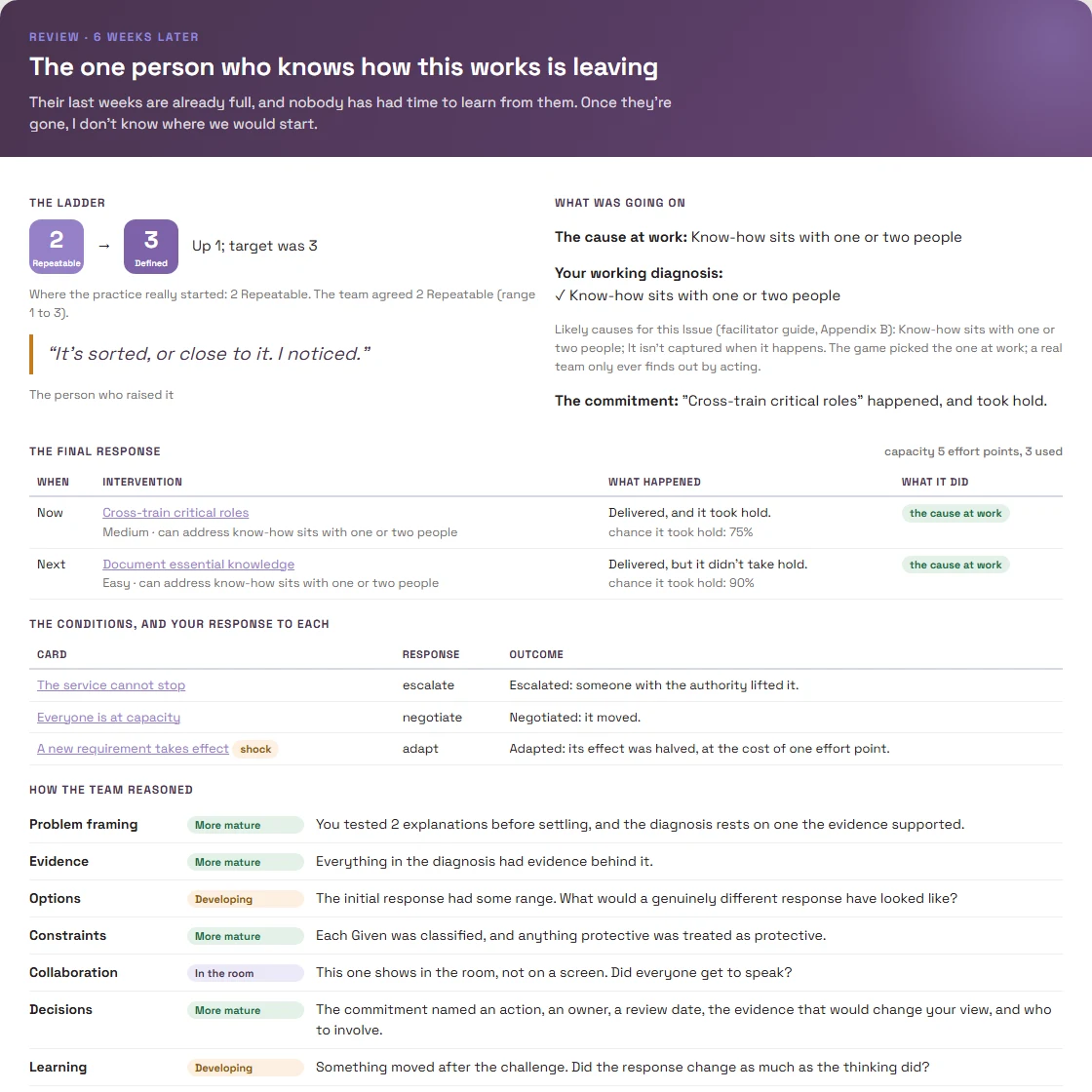
The game also runs on screen, on the same A3 canvas and the same cards. A team can play a session at a laptop, watch a computer team play one through, or use it to prepare for a facilitated session. On screen, the Review shows what happened: which Interventions took hold, what the conditions did, and how the team reasoned, as observations rather than a score.

The Review on screen for the same session: the practice re-rated from 2 Repeatable to 3 Defined, the customer's verdict, the cause at work beside the team's diagnosis, what each Intervention did, the response to each constraint, and the seven reasoning dimensions as observations rather than a score
The Review, six weeks later: what happened, what was really going on, and how the team reasoned. Illustrative example, ABC Demo Organisation.
What a session produces

The record belongs to the team

For the sponsor

  • A one-page session summary: the focus issue(s), the Team's stated maturity rating and its range, the initial and final response and what changed, the proposed commitments and their owners, and the team's self-evaluated reasoning ratings
  • The team reads it back and agrees it may leave the room
  • Referrals, where the diagnosis suggests exploring another domain
  • Improvement session on session, from the Review re-ratings

Made yours: the client edition

  • Who-can-help cards for your own teams and functions, with what each can decide, advise on and provide
  • Your own systems, policies and standards named in the card text
  • Issue cards from your own people's experience, written in their voice
  • The cards your teams write on blanks during sessions, made permanent
A typical engagement: an hour with the sponsor to define the situation and team, an hour or two of the team playing the game, and an hour or so to compile and share the report.

Run a session with your team

A first session on a Random Game takes about an hour. Bring four to eight people and a problem worth talking about.

Last updated 24 September 2026